





Articular fractures (broken bones in a joint) bring additional considerations to the repair methods used. It is essential to re-establish the articular surface congruity otherwise severe DJD will develop quickly. The most common articular fractures we see are distal intercondylar humeral & femoral fractures in young animals or Spaniels & acetabular fractures.
Specialist Veterinary Fracture equipment
Stryker system 2000 autoclavable battery drills
External fixators- Imex © linear & Circular (CESF)
Synthes small and mini fragment instrument sets & surgical implants
Stainless steel & Titanium AO/ASIF plating
3M mini driver system
ACE cannulated screw system
Articular Fractures
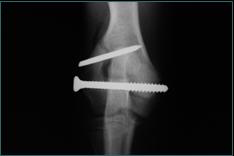
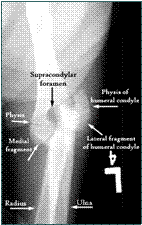
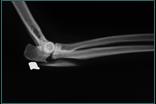
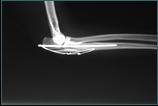

Lateral condylar fracture of the humerus in an immature dog
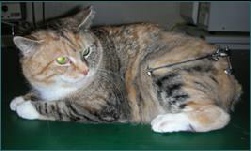
Gun shot injury in a cat causing an articular ulnar
fracture. Air gun pellet can be seen just behind the joint
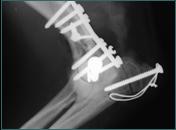
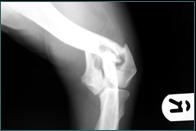
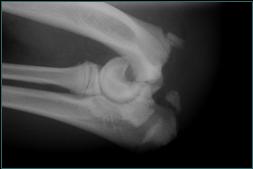
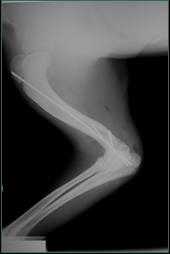
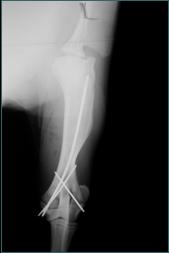
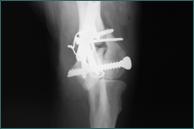
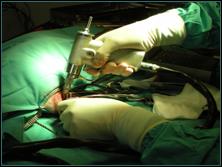
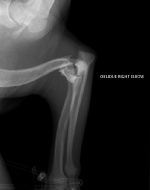
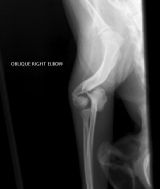
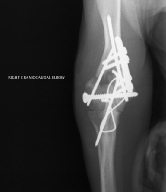
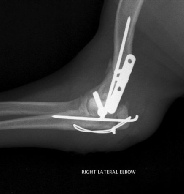
Y fracture or T fracture of the distal humeral condylar fracture in an adult spaniel. Repair after olecranon osteotomy with a transcondylar lag screw, anti rotational K wire, supra -condylar lag screw and K wire and 7 hole plate applied to Medial humeral condylar ridge. Ulnar repaired with lag screw and tension band wire.
Y fracture or T fracture distal humeral condylar fracture in an immature CKCS spaniel. Repair after olecranon osteotomy with a transcondylar lag screw, crossed K wires and a plate applied to the medial humeral condylar ridge. Ulnar repaired with pin and tension band wire.
Distal humeral epiphysial fracture
For more on orthopaedic topics select from the drop down box below:
| elbow arthroscopy key hole surgery dog ireland |
| elbow dysplasia |
| vet-arthroscopy-shoulder ocd-dog |
| shoulder arthroscopy dog- ligament injury |
| stifle arthroscopy dogs |
| hip arthroscopy dog |
| spinal xray myelogram |
| GSDA A stamp |
| elbow score |
| hip score |
| hip score guide for owners |
| directions |
| site map |